BubbleSenses

Shrinking Surface Bubble Deposition

A light-made bubble that gathers what is hiding in your water

BubbleSenses builds sensing technology on a patented method that concentrates nanoscale particles from less than 1 mL of liquid into a single spot, where they can be identified and imaged. Our first application is nanoplastics in water.

< 1 mL
of sample per measurement, with no ultrafiltration
~1,000×
local concentration compared with drop-cast evaporation
~3 µm
deposit that can be read by Raman and electron microscopy
30 nm
smallest polystyrene particles detected to date

The problem

Nanoplastics are in the water, and no routine tool can see them

Plastic debris weathers into particles smaller than 1 µm. Micro- and nanoplastics have now been reported in human blood, placenta, brain tissue, and arterial plaque, and regulators have started to act: in April 2026 the U.S. EPA placed microplastics on its draft Contaminant Candidate List for drinking water.

  • Mass-based methods

    Pyrolysis GC/MS reports bulk polymer mass after about a day of sample preparation, with no particle count, size, or shape.

  • Optical microscopy

    FTIR and Raman microscopes identify polymers but lose particles smaller than about 1 µm.

  • Particle counters

    Tracking and light-scattering instruments size particles but cannot tell a plastic from a mineral.

How SSBD works

Concentrate first, then measure

Instead of building a more sensitive detector, SSBD solves the step before detection. It gathers the particles into one place, so that ordinary instruments can read them.

SURFACE
  1. 01

    Mix

    Plasmonic silver or gold nanoparticles are added to a small volume of the liquid sample. No ultrafiltration step is needed to concentrate the particles.

  2. 02

    Grow

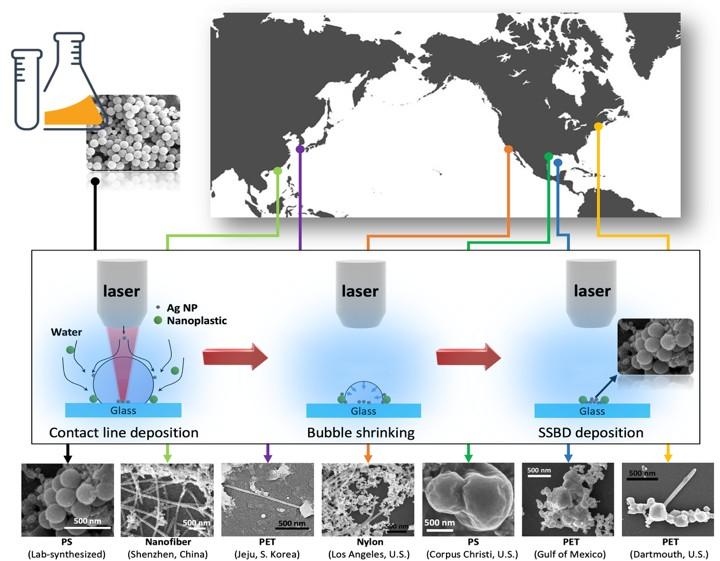
    A focused continuous-wave laser heats the particles at a surface and nucleates a microbubble. The temperature gradient drives a flow that sweeps suspended particles to the bubble's contact line.

  3. 03

    Shrink

    The laser is switched off. As the bubble cools and shrinks, its contact line retracts toward the center and carries the collected particles inward.

  4. 04

    Read

    When the bubble vanishes, the targets and plasmonic particles sit together in one island a few micrometers across, ready for surface-enhanced Raman spectroscopy (SERS) and imaging.

More on the technology →

Published results

What SSBD has shown so far

Ocean water

First direct observation and identification of nanoplastics in ocean water

SSBD resolved polymer type (nylon, polystyrene, and PET) together with particle shape (nanofibers, flakes, and ball-stick particles) in seawater from several regions, including samples taken from more than 300 m depth in the Gulf of Mexico.

Science Advances, 2024 [1]
Drinking water

Nanoplastics identified in bottled and fountain water

SSBD identified polyamide in commercial bottled water and polypropylene in fountain water, and detected polystyrene at concentrations down to 0.001 ng/mL for 30 nm particles.

Preprint, 2026 [2]

Hardware

An automated bubble unit that ran on the International Space Station

A shoebox-scale, automated plasmonic-bubble instrument operated aboard the ISS to study bubble dynamics in microgravity. It showed plasmonic bubble generation running in a compact, automated unit.

npj Microgravity, 2024 [4]

World map of seawater sampling sites, the three stages of SSBD, and electron microscope images of nanoplastic particles found at each site.
Nanoplastics captured by SSBD in ocean water from several regions, with electron microscope images of polystyrene, nylon, and PET particles. [1]

Have a sample you want to look at?

We run sample testing and pilot evaluations with laboratories, utilities, and producers.

Request sample testing