Technology
Shrinking Surface Bubble Deposition
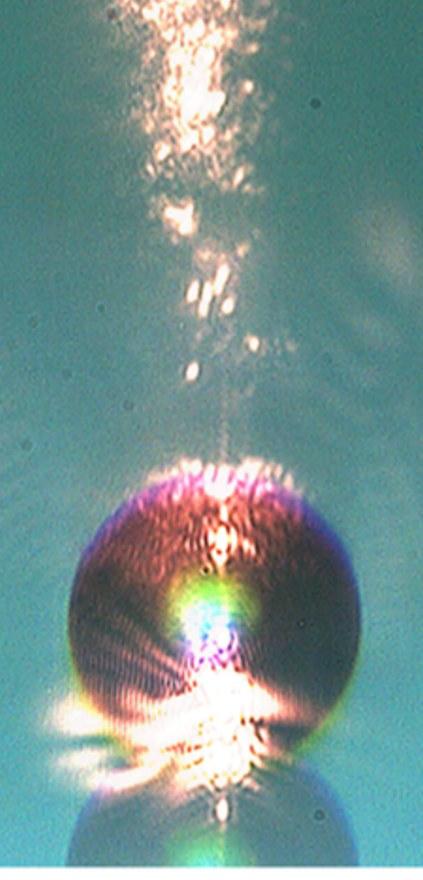
SSBD uses a laser-generated microbubble to collect particles from a liquid and deposit them in an island a few micrometers across. It was invented by researchers at the University of Notre Dame and is licensed to BubbleSenses.
The cycle
One bubble, four steps
- 1
Mix
Plasmonic silver or gold nanoparticles are added to a small volume of the liquid sample. No ultrafiltration step is needed to concentrate the particles.
- 2
Grow
A focused continuous-wave laser heats the particles at a surface and nucleates a microbubble. The temperature gradient drives a flow that sweeps suspended particles to the bubble's contact line.
- 3
Shrink
The laser is switched off. As the bubble cools and shrinks, its contact line retracts toward the center and carries the collected particles inward.
- 4
Read
When the bubble vanishes, the targets and plasmonic particles sit together in one island a few micrometers across, ready for surface-enhanced Raman spectroscopy (SERS) and imaging.
Why it is different
What the bubble makes possible
It works upstream of the detector
The limiting step in nanoplastic analysis is getting enough particles in front of the instrument. SSBD concentrates them roughly a thousand-fold compared with letting a drop evaporate, so a portable Raman module can acquire a spectrum in seconds.
It is gentle
The laser is off while the bubble shrinks, so the collected targets are not exposed to high temperatures. DNA-functionalized nanoparticles survive the process intact, and particle shape is preserved for imaging.
Chemistry and shape from the same spot
The plasmonic particles are deposited together with the targets, which produces the surface enhancement that SERS needs. The same island can then be imaged by electron microscopy.
No ultrafiltration
A measurement uses less than 1 mL of sample, and the bubble does the concentrating. There is no need to pass liters of water through a nanometer-pore membrane to collect enough particles, a slow step that can clog and can lose fibers and other elongated particles.
Compared with existing methods
Each current method gives up something
Shape, polymer identity, and sensitivity below 1 µm are rarely available together. [5]
| Method | Size range | Particle shape | Polymer identity | Sample preparation |
|---|---|---|---|---|
| Pyrolysis GC/MS | Bulk mass only | No (destructive) | Yes (bulk) | Filtration and about 24 h of digestion |
| FTIR microscopy | Above about 1 µm | Yes | Yes | Filtration |
| Raman microscopy | Above about 1 µm | Yes | Yes | Filtration |
| Particle tracking and light scattering | 30 nm to 1 µm | Size only | No | Minimal |
| SSBD | 30 nm to 100 µm | Yes | Yes (SERS) | No ultrafiltration; less than 1 mL |
From laboratory method to instrument
Compact, automated hardware
BubbleSenses is developing a benchtop analyzer that pairs automated bubble deposition with spectral and image analysis. The animation below shows our concept design: the optical path, the sample handling, and how a measurement is read out.
References
Publications and patent
- [1]S. Moon et al., "Direct observation and identification of nanoplastics in ocean water," Science Advances 10(4), eadh1675 (2024). Link
- [2]Y. Liu et al., "Ultrasensitive nanoplastics detection leveraging shrinking surface plasmonic bubble," arXiv:2604.10871 (2026). Link
- [3]S. Moon et al., "Biocompatible direct deposition of functionalized nanoparticles using shrinking surface plasmonic bubble," Advanced Materials Interfaces 7, 2000597 (2020). Link
- [4]Q. Zhang et al., "Bubble nucleation and growth on microstructured surfaces under microgravity," npj Microgravity 10, 13 (2024). Link
- [5]R. Zhang et al., "A review of advancements and challenges in nanoplastics detection," Cell Reports Physical Science 7(1), 103042 (2026). Link
- [6]"Systems and methods related to particle deposition," U.S. Patent 12,703,660, issued August 11, 2026.
Have a sample you want to look at?
We run sample testing and pilot evaluations with laboratories, utilities, and producers.